
The IT project management talent gap is growing—but what if the real issue isn’t a shortage, but a lack of imagination? Discover how transferable skills, creative recruitment, and Project Management as a Service (PMaaS) can help close the gap and keep critical projects on track.
Every year, “Talent shortage” tops lists of project management’s biggest challenges for the year ahead!
From what I’ve seen, this year is no different.
Scrolling last year’s news is telling. Reports of delayed NHS initiatives, stalled infrastructure projects, local council IT fails, struggling technology rollouts, ERP gone bad, vulnerable but essential cloud services … all (at least partly) caused by the issue we talk about but never properly address: the critical shortage of skilled IT project management professionals.
Last year, the PMI’s Global Project Management Talent Gap report predicted that worldwide demand for project talent could grow by 64% by 2035. By that year, we could face a shortfall of up to 29.8 million qualified project professionals. The risk to business transformation initiatives between now and then is almost unthinkable; the time to act and protect these critical future projects is slipping away – fast!
Here at Stoneseed and our sister company, P3M Recruitment, clients repeatedly tell us of talent gaps and shortages – and we’re happy to help fill them. A Project Management as a Service provider or a recruitment partner that knows where to find the exact IT project talent you need is a godsend.
There’s a trend that my sales colleagues are noticing. New clients are contacting us, sometimes years after our initial cold call was met with a reply like “full bench, no need for your services”.
Suddenly, they don’t have a full in-house team. That’s the problem with a global skills shortage –there’s a growing abundance of opportunities to lure talent away. When this happens, you might find that the market for replacing key talent is very different from how it was when you initially hired them.
You know where we are.
But … what about the wider industry? Is it time to completely rethink where IT project talent comes from – there’s 29.8 million reasons why the answer is “YES”
The usual response has been to search harder, post longer job ads, pay higher salaries, broaden requirement criteria … all while critical business IT initiatives slow down or stall entirely. But what if part of the problem isn’t a lack of talent… but a lack of recruitment imagination?
In this series of blogs, let’s reframe the problem. Let’s get creative and imaginative.
What if some of the best future IT project managers aren’t currently called “project managers” at all?
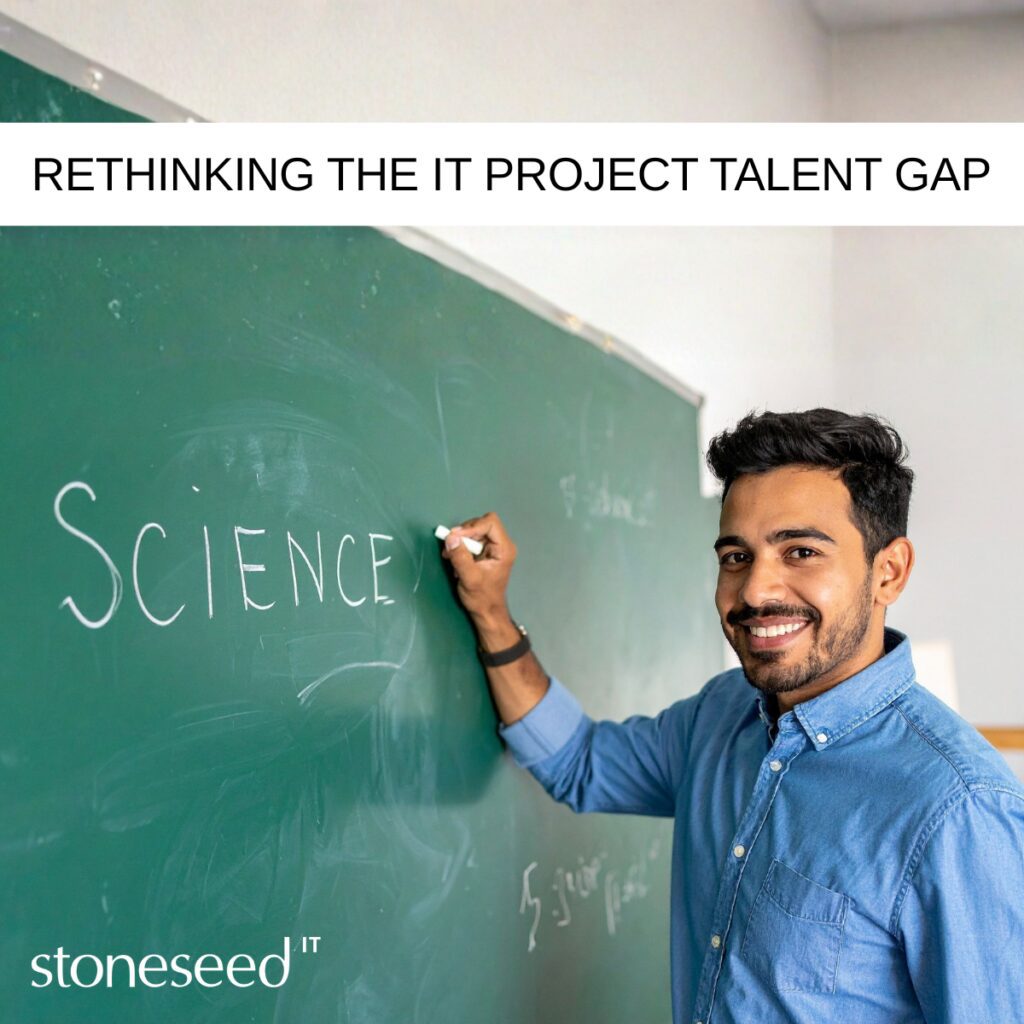
During the recent holidays, I met and got talking with a newly retrained and reskilled IT Project Manager. In his late 30s, Brent is a former science teacher who had grown “cheesed off” with the education system. I was fascinated by the transferable skills he had brought to our industry.
This conversation with Brent got me thinking – maybe we don’t collectively cast our nets wide enough.
Your next great PM could be a science teacher! Imagine the chemistry!
The skillset parallels are clear …
TRANSFERABLE SKILLS OF A SCIENCE TEACHER
1 – Science teachers don’t cling to outcomes – they test them
In science, certainty is the enemy of progress. Teachers are trained to treat ideas as hypotheses: this might work, let’s test it, observe the results, and adjust.
That mindset is almost a perfect match for modern IT project delivery.
Requirements change. Assumptions fail. Technology evolves mid-project. The worst project managers are emotionally attached to a plan that no longer makes sense. The best ones are comfortable saying, “The data’s changed … let’s adapt.”
Science teachers live in that space every day.
2 – They Approach Each Experiment With An Open Mind
I asked Brent what his “fresh pair of eyes” had noticed about how we do things.
He explained that his science teacher’s mind led him to treat each new IT project like a new experiment, whereas most PMs he had worked with had adopted what he called a “playbook approach”, i.e. they’d run the new project the way they’d run previous ones because, well, that’s the way it’s done.
He’s right, isn’t he?
We’ve all been guilty of getting stuck in our ways, but by taking Brent’s approach, valuable new learning emerges from trying new ideas.
3 – They’re experts at translating complexity
Explaining abstract, technical concepts to a room full of teenagers with varying levels of interest and understanding is not a soft skill – that’s a superpower.
Stakeholder management in IT projects requires the same capability. Developers, executives, users, vendors, and compliance teams all need different explanations of the same reality. Science teachers instinctively adapt their language without losing accuracy or credibility.
They know how to make complexity understandable — and that’s often the difference between alignment and chaos.
4 – Process matters as much as results
In science education, how you arrive at a conclusion matters just as much as the conclusion itself. Documentation, methodology, repeatability, and peer review – foundational.
Strong IT project management works the same way.
Clear governance, decision logs, testing strategies, and post-implementation reviews aren’t bureaucracy; they’re how organisations learn and improve. Science teachers naturally value these disciplines because they’ve seen firsthand what happens when process is ignored.
5 – Decisions are evidence-based, not opinion-led
Science teachers are trained to ask uncomfortable but essential questions: What’s the evidence? What does the data actually show? What assumptions are we making?
In project environments, this mindset cuts through politics and wishful thinking. It replaces gut feel with facts, reduces emotional escalation, and helps teams make defensible decisions under pressure.
It’s a skill many organisations say they want but rarely screen for explicitly.
6 – Risk management is second nature
Before a lab session even begins, a science teacher has already assessed risks, controlled variables, and planned contingencies.
Translate that into IT delivery, and you have someone who instinctively looks for early warning signs, understands downstream impacts, and knows how to prevent small issues from becoming production incidents.
Good project managers can’t always eliminate risk but they surface it early and manage it intelligently. Science teachers are trained to do exactly that.
7 – They manage diverse groups with limited authority
A classroom is a masterclass in stakeholder management. Different personalities, motivations, learning speeds, and attention levels — all without the luxury of formal authority or financial incentives.
Sound familiar? If you interviewed someone with those skills – you’d probably hire them!
IT project managers often operate the same way: coordinating specialists they don’t manage directly, aligning priorities across teams, and keeping momentum without micromanagement. Science teachers have been doing this for years.
HUGE POOL
Obviously, it’s not just science teachers we should be looking at! I just happened upon one who was now a great IT Project Manager, but think of the potential talent pool!
Hiring organisations are often searching for titles, not capabilities. They want someone who has already done the job, in the exact same context, with the same tools, under the same conditions. In a constrained market, you’ll find that at best competitive, at worst unrealistic.
Of course, critical projects can’t wait for the perfect hire, or for you to tap up your kids’ chemistry teacher at parents’ evening. I get that!
While organisations worldwide rethink how to identify and develop new project management talent, delivery still has to happen. NOW, not in 12 months, and for that … there’s always Project Management as a Service!
Project Management as a Service (PMaaS) provides immediate access to experienced, adaptable project leaders who already bring the mindsets described above: experimental, evidence-driven, comfortable with ambiguity, and focused on outcomes.
Remember, PMaaS is not just about replacing internal capabilities; it’s often about complementing them, bridging gaps, accelerating delivery, and reducing risk while your longer-term talent strategy catches up.
EXPERIMENT
Maybe you have never tried PMaaS.
You’ll find it worth the experiment!
Get in touch and let’s talk.
I’d also love to hear what industry you were in before retraining as a project manager, or the successful PM hire you made from outside the typical talent pool, because I bet Brent is not alone.
Happy hiring!
More about Project Management as a Service from Stoneseed
SOURCES
https://www.pmi.org/learning/thought-leadership/global-project-management-talent-gap
https://www.stoneseed.co.uk/project-management-as-a-service/