Explore the strategic value of thinning and how this simple gardening principle translates into smarter project management.
Project Management inspiration can come from truly anywhere, can’t it?
I just visited recently retired Project Guru Frank. Frank has been a mentor to many over the years. Without realising, he still is.
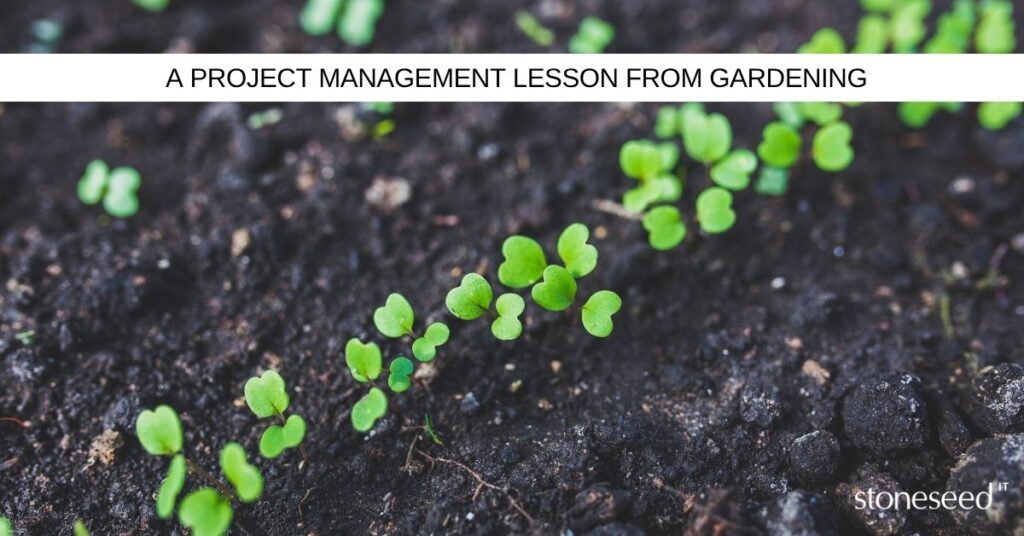
As we walked around his garden, in the sunshine, something Frank kept doing intrigued me. Every few steps, Frank crouched down, plucked a seemingly healthy shoot from the soil and either tossed it in his wheelbarrow to compost or replanted it elsewhere.
In gardening, I learned, this practice is called thinning.
I thought Frank was having “a moment”.
In spring, when new shoots are pushing through, and everything looks full of promise, the experienced gardener walks the beds and removes plants, not just the failing ones, not just the diseased ones, but healthy ones too, ones that are growing exactly as they should. The logic is counterintuitive until you understand it: left unchecked, too many healthy plants competing for the same soil, light and water means none of them can reach their potential.
>>> A PMO gives you the structure to make these thinning decisions with confidence, not guesswork. Explore Stoneseed’s PMO Services → <<<
Why am I sharing this in a Project Management blog?
Am I having “a moment” too?
No, as Frank and I walked and talked, it increasingly struck me as a great metaphor for portfolio management. Like the soil, light and water, our project resources have limits, spread them too thinly and good projects, projects that are progressing well, can soon start to wither.
How often are the hardest problems in a project portfolio not the ones that are visibly failing?
THE PORTFOLIO THAT LOOKS FINE
Imagine a portfolio review where every status is green or amber.
Delivery is progressing. Teams are engaged. Sponsors are satisfied.
On paper, everything looks healthy.
And yet something feels off. Been there? Me too.
Strategic initiatives are moving slowly. Key people are stretched.
There’s a lot of activity but not much momentum.
Leadership keeps asking why the big things aren’t landing.
The answer is rarely one bad project. It’s usually three or four good ones quietly consuming the capacity that the critical work actually needs. Like an overcrowded flower bed, everything is technically alive, but nothing has room to fully grow.
GOOD VS. GOOD IS THE HARDEST DECISION IN PORTFOLIO MANAGEMENT
Prioritisation frameworks tend to assume a relatively clear hierarchy, high strategic value beats low, high ROI beats low, but the genuinely difficult portfolio decisions aren’t between strong and weak. Instead, they’re between two things that are both legitimate, both progressing, both backed by your stakeholders.
The gardener faces the same problem.
The shoots being removed aren’t failures, they’re just occupying space that something else needs more. That distinction matters, because it means the decision can’t be made on quality alone. It has to be made on fit, on timing, on what the soil can actually support right now.
That’s where most internal PMOs stall. There’s no clean objective basis for the call, the politics are complicated, and the people closest to the work have too much invested to recommend pausing something that isn’t visibly broken.
HOW PORTFOLIOS GET SATURATED
It usually happens in a moment of organisational optimism.
After a period of constraint (budget freeze, restructuring, strategic pause), energy returns, and the instinct is to move fast. Initiatives that were parked get restarted. New opportunities get approved. Every yes is genuine; every sponsor has a legitimate case. Green lights everywhere.
The portfolio fills up quickly and, for a while, it feels like progress.
The problem surfaces later, and quietly.
Delivery teams are spread across too many priorities. The two or three initiatives that actually need to land this year are competing for attention with everything else. Progress is happening everywhere and completing nowhere. The garden looks full, but nothing is fruiting properly.
For example, imagine an organisation running three separate digital transformation initiatives at the same time: a CRM replacement, a customer portal redesign and a finance system upgrade. All three are worthwhile. All have strong sponsors. All are showing green status in the monthly review.
The problem is that each project depends on the same enterprise architect and the same senior Business Analyst.
Neither person is formally overallocated on paper, but in reality they are splitting their time across workshops, design reviews, decisions and stakeholder conversations for all three. As a result, each project keeps moving, but more slowly than planned. Decisions are delayed. Dependencies stack up. Teams lose momentum while they wait.
Individually, none of the projects looks unhealthy. Portfolio-wide, however, the organisation has created exactly the kind of overcrowding that stops the most important work from thriving.
If the CRM replacement is the initiative that matters most this year, the better decision may be to “thin” the portfolio: pause the portal redesign for three months, sequence the finance upgrade later, and allow the critical people to focus properly on the CRM. Suddenly, one project has the space to move decisively, rather than three competing to make limited progress.
By the time it’s visible, months have been lost.
Another gardener I know has always said she’d rather her trees grew a handful of apples that taste delicious than a barrow full of sour ones – I get it now. It’s a lesson our portfolios could benefit from.
WHAT A PORTFOLIO THINNING ACTUALLY INVOLVES
The answer isn’t always to cut.
Sometimes it’s sequencing, moving something genuinely valuable to a later phase when the capacity to do it properly exists.
Sometimes it’s descoping.
Sometimes it really is pausing something that, judged on its own merits, would be worth running.
What it requires is an honest assessment at the portfolio level rather than the project level:
- Where is your real delivery capacity – not headcount on paper, but actual senior bandwidth?
- Which projects are competing for the same scarce people, and which of those is most critical to your strategy this year?
- Which initiatives are progressing adequately but occupying space that higher-priority work actually needs?
- What would the portfolio look like if you focused deeply on the few initiatives that matter most, rather than spreading effort across everything?
These questions are straightforward.
Getting honest answers from inside the organisation is the hard part.
THE VIEW YOU CAN’T GET FROM INSIDE THE GARDEN
This is where proximity becomes the real problem. When you’re inside the organisation, you see each project individually: the team behind it, the effort that went into getting it approved, and the genuine progress it’s making.
What you often can’t see from that position is what it’s costing everything else.
An experienced external perspective can change that dynamic.
Not because outside eyes are smarter, but because they’re not carrying the history of every decision that shaped the portfolio. They can look at what the organisation is genuinely trying to achieve, map that against where delivery capacity is actually going, and make recommendations that an internal team might struggle to make about itself.
Telling a senior stakeholder that their project, the healthy one, the one delivering, the one they’ve championed, needs to step back to protect something more strategically critical is a genuinely difficult conversation. It requires portfolio-level visibility, clear strategic rationale, and enough distance from the internal dynamics to say it plainly. Ironically, this was the kind of thing Frank was brilliant at – and now I know why!
That’s also a significant part of what good PMaaS delivers.
As well as flexible, cost-effective access to experienced Project Managers, Business Analysts and PMO specialists (without the overhead of permanent hires), it’s the capacity to look at the whole garden, not just the individual plants, and make the call that creates room for what matters most to flourish.
Of course, sometimes all the flowers in your project garden aren’t blooming because your team is overstretched. At Stoneseed, we have a tried and tested fix for that too!
More about Project Management as a Service from Stoneseed
>>> More straight-talking insight on smarter IT project management — Download the free Straight Talk on Project Management eBook → <<<