When we started writing these Straight Talk on Project Management blogs, we committed to never write about three taboos: religion, s*x and politics.
I’m sorry to break a third of that promise! In my defence, a new Association for Project Management (APM) report made me do it.
My friend Andy, a public sector IT Project Manager, half-jokes that multi-agency government programmes now run on two clocks: the delivery plan and electoral cycle – and party politics almost always wins.
THE IMPACT OF POLITICS ON PROJECT SUCCESS
A new APM study, ‘The Impact of Politics on Project Success in Multi-Agent Projects’, written by Professor Amos Haniff, Professor Laura Galloway and Isabel Gillert, backs up Andy’s quip and lays bare how manifesto promises, ministerial churn and cross-party conflict routinely distort priorities and timelines in complex multi-stakeholder government projects — and it makes fascinating reading.”
And, I think, it raises a question for CIOs: not how to keep politics out of programmes, but how to design delivery that survives it.
I think it also hints at the need, not just in public sector IT, but across all complex delivery environments, for a neutral and consistent delivery backbone.
WHEN PARTY POLITICS COLLIDES WITH IT PROGRAMMES
While the report focuses squarely on national-level public projects involving ministers, parliament and senior civil servants, I question whether any IT project portfolio is immune from changes in political will.
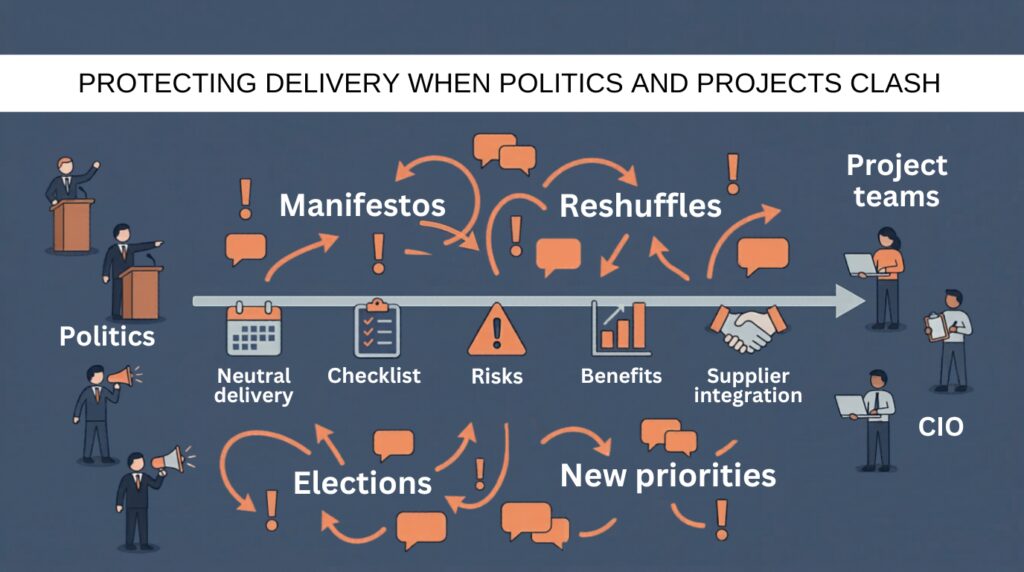
The report describes public sector programmes that change shape after each election, dependencies that are rearranged after every reshuffle, and delivery teams left to reconcile incompatible promises made at the dispatch box.
PM Andy tells me that the patterns are painfully familiar:
Manifestos commit to ambitious outcomes and dates before delivery teams have even sized the work.
New ministers inherit programmes mid-flight and seek visible resets to signal political difference.
Cross-party point-scoring turns programme milestones into opportunities for blame rather than collaboration.
Under these conditions, traditional project disciplines struggle:
Roadmaps become political artefacts as much as technical ones.
Risks are suppressed if they cut against the prevailing narrative.
Governance forums are overloaded with stakeholders whose primary accountability is to their party or department, not to the programme as a whole.
The APM research is clear: these programmes are not failing because project managers cannot use Gantt charts. They struggle because the delivery system itself is not designed for political volatility.
WHAT THE RESEARCH ACTUALLY RECOMMENDS
Crucially, the report does not indulge in wishful thinking about apolitical government. It assumes politics will continue to shape priorities, funding and public commitments.
Instead, it surfaces several themes that should catch a CIO’s eye:
Depoliticise day-to-day delivery while accepting politics at the top.
Strengthen governance and accountability so decisions and trade-offs are transparent.
Invest in professional project capability that can operate across departments and electoral cycles.
In other words: get clear about where politics legitimately belongs, in choices about outcomes, scope and public value, and where it is actively harmful, such as task-level planning, risk assessment and vendor management.
WHAT THIS MEANS FOR CIOS
Reading the report, and hearing Andy’s stories, got me thinking about the poor CIOs and project teams who actually have to navigate all this.
They sit at the intersection of policy ambition, organisational complexity and delivery reality. They cannot remove politics from programmes, but they are still expected to deliver outcomes that often span multiple departments, suppliers and parliamentary cycles.
That raises a practical question: if political volatility is inevitable, how do you design a delivery model that remains stable even when the political environment is not?
The uncomfortable reality is that many government programmes still treat delivery capability as a temporary staffing question rather than a permanent part of the delivery architecture.
Teams assemble around a programme, disperse after a reshuffle, and rebuild again when the next initiative appears. Yet the political environment surrounding these programmes is anything but temporary.
If politics is a structural feature of public programmes, perhaps delivery capability should be designed with the same permanence in mind.
DESIGNING A NEUTRAL DELIVERY BACKBONE
One response is to stop thinking of delivery purely as staffing and instead treat it as infrastructure, a managed service with its own mandate and safeguards.
Instead of each department building its own project team, you establish, or bring in, a neutral delivery backbone that supports the entire multi-agency programme.
In practice, that means a service-based project and PMO capability providing planning, reporting, RAID management, benefits tracking and integration of supplier plans across the programme.
If that sounds familiar, it is: Project Management as a Service (PMaaS)!
Crucially, in the context of the APM report, this backbone would operate with three characteristics:
Politically neutral
Accountable to agreed outcomes and service measures, not to any single party or department.
Cross-cutting
Spanning all participating agencies and major suppliers rather than sitting inside one organisational silo.
Method-led
Using common standards, artefacts and cadences across the entire programme.
Senior politicians still debate what should be done, in what order, and with what money. However, once those decisions are made, the neutral backbone is responsible for turning them into credible delivery plans and surfacing the consequences when political aspiration and operational reality diverge.
So, you are not removing politics from the system, you are simply stopping it from editing the RAID log every week.
SURVIVING RESHUFFLES AND MANIFESTO WHIPLASH
For CIOs, one of the most corrosive features of political systems is churn.
Ministers move, priorities get re-branded, and programmes are re-announced under new banners. Every change risks resetting expectations and losing institutional memory.
A service-based delivery capability provides an important counterweight:
Continuity of capability – core project leadership and PMO functions remain stable over the life of the programme.
Structured impact assessment – policy changes can be modelled quickly against scope, cost and timeline.
Evidence-based conversations – incoming ministers see the trade-offs grounded in data, not just narratives optimised for political comfort.
Political decisions will still be made, but they are made with clearer visibility of the consequences.
MANAGING MULTI-PARTY POWER, NOT JUST PROCESS
The APM research emphasises that in multi-agent public projects, power is fragmented. Departments hold different budgets, committees hold different vetoes, and suppliers hold critical knowledge.
Formal governance often masks a complex web of informal influence and political pressure.
A neutral delivery service cannot redraw those lines of power, but it can make them easier to manage:
Clear decision rights that define who can approve what.
A single version of the truth for schedules, risks and performance.
Structured escalation paths when conflicts arise between agencies or suppliers.
For CIOs, this changes the character of governance. Instead of arguing over whose spreadsheet is correct, political debate can focus on what to do about known constraints and risks.
Over time, this kind of shared delivery infrastructure can also foster a cross-department community around major programmes. Because the capability sits outside any single policy silo, it can convene agencies and suppliers around shared delivery outcomes rather than organisational boundaries.
THE CIO’S REALITY
The APM report is a useful reminder that politics is not background noise for government CIOs. It is a structural feature of the operating environment.
Party agendas, parliamentary cycles and ministerial careers all shape the conditions under which programmes must be delivered.
You cannot solve that with better templates alone.
But you can design delivery models that are resilient to political change – separating political choice from operational control, maintaining continuity of capability across reshuffles, and creating a trusted source of delivery truth across departments.
CIOs who make that shift are not opting out of politics.
They are designing programmes that can survive it.
In a world of manifesto whiplash and permanent campaign mode, that may be the most practical response of all.
More about Project Management as a Service from Stoneseed
Source