Most organisations come to PMaaS for the capacity. The ones who get the most from it treat it as a genuine working partnership. Here’s what that really looks like.
We’re noticing a pattern when organisations first come to us.
They’ve got too many projects, not enough people, and a leadership team that’s spending so much time buried in delivery that nobody’s actually steering the ship. The answer, they’ve decided, is to outsource the project management. Free up the bandwidth and get back to running the business.
And that’s fine.
It’s a perfectly reasonable starting point. In fact, that’s how we’ve been helping clients for nearly two decades.
But if “outsourcing” is where the thinking stops, you’re potentially missing out on the real value of PMaaS.
PMaaS Has Matured
When Project Management as a Service first emerged as a model, it was largely about capacity. And while it was very successful, it was also pretty transactional.
You needed project managers. We had project managers. There you go.
Simple.
That’s changed.
Today, the organisations getting the most from PMaaS aren’t the ones treating it as a staffing tap they can turn on and off, although having that flexibility available remains one of the model’s biggest advantages.
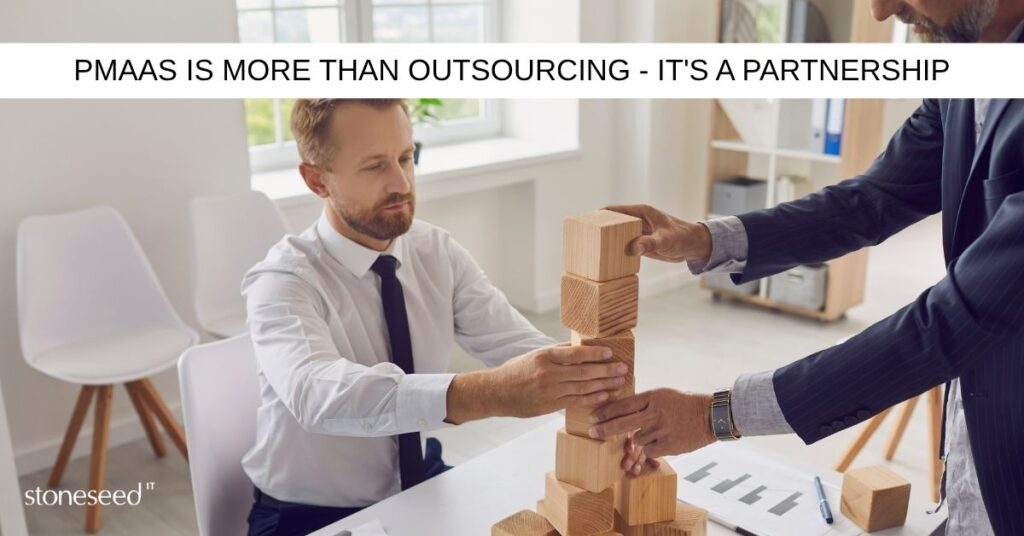
The real value is gained by the organisations that treat PMaaS as a working partnership, where both sides are genuinely invested in the outcome.
That’s certainly how we approach it.
Over time, we noticed that the client relationships delivering the best results weren’t the ones where we parachuted in, delivered a project, and disappeared again. They were the ones where we became part of the fabric of how a team worked. Where we were involved in the thinking, not just the doing.
That’s the model we’ve built our modern PMaaS offering around, and it’s one that continues to evolve alongside the needs of our clients.
We’re Not Here to Replace Your Team
This matters, and it’s worth saying plainly.
The best results don’t come from replacing your project management capability. They come from strengthening it.
There’s a difference between a supplier who fulfils a requirement and a partner who helps an organisation become more capable. At Stoneseed, our focus is on being the latter.
In practice, that might mean working alongside an existing PM team, helping to embed better processes, or supporting a PMO that’s still finding its feet. It might mean scaling up for a particularly demanding programme and stepping back once internal capacity catches up.
Partnership also means access to a wider range of experience than any one individual can provide. Behind every engagement sits a broader network of project delivery professionals, PMO specialists, business analysts and technical advisors who can be brought in as challenges evolve.
The goal isn’t dependency.
It’s interdependency.
That means your capability growing, with our support alongside it.
Flexibility: Not Just a Feature, It’s the Foundation
Our model is still built around on-demand resourcing, which means you get what you need, when you need it, without carrying the overhead when you don’t.
Full-time, part-time, ad hoc. Whether you need access to a single resource for a flexible period or a fully managed service, we have a pool of Programme and Project Management specialists who are experienced practitioners across the full spectrum of projects and programmes — in fact, anything with an IT flavour.
Need capability scaled up for a complex transformation programme? Need it scaled back once it lands?
No problem.
That flexibility is commercially useful, of course. No bench costs, no IR35 headaches, and no recruitment gambles.
And in the current climate, those pressures are being felt more acutely. As organisations look more closely at where every pound is spent, there’s a natural tendency to prioritise lower-cost options or delay investment in external capability altogether.
On the surface, that can feel like prudence, but in practice it often shifts costs rather than reducing them.
When delivery teams are already stretched, the real cost isn’t always visible in the day rate, it’s in lost momentum, delayed decisions, and the compounding impact of under-resourced change.
Which is why flexibility alone isn’t the full story.
Flexibility isn’t just about cost control.
It’s what makes genuine partnership possible.
In an environment where priorities can shift quickly, the ability to scale expertise up or down without lengthy recruitment cycles gives organisations a level of agility that’s increasingly difficult to achieve through traditional resourcing models alone.
A rigid, heavily contracted arrangement doesn’t leave much room for the kind of honest, adaptive working that gets projects delivered well.
When we flex to fit your needs, you get the capacity you need.
When you trust us to become part of your team rather than keeping us at arm’s length as a vendor, you get something more valuable than capacity.
You get momentum.
Sometimes the Most Valuable Thing We Bring Isn’t Capacity
Of course, we love the calls asking for a project manager for a month. Please keep those coming.
But there is something particularly rewarding about the calls asking for strategic advice, a fresh perspective, or a second opinion on a challenge that’s proving difficult to solve.
Sometimes the most valuable contribution isn’t additional resource at all.
It’s an independent viewpoint.
A fresh pair of eyes can often spot risks, opportunities or assumptions that are difficult to see when you’re living with the day-to-day pressures of delivery.
To be trusted at that level is a privilege, and it’s often where we can create the greatest value.
Here’s What Nobody Talks About
Efficiency is easy to sell.
You can buy efficiency almost anywhere.
What’s harder to find, and harder to build, is a working relationship where both sides are genuinely pulling in the same direction.
Where the project managers embedded in your organisation aren’t simply ticking off tasks, but genuinely care whether the project succeeds.
Where there’s enough trust to have the difficult conversations early, before small problems become expensive ones.
Where knowledge is shared, capability grows, and your organisation becomes stronger after the engagement than it was before.
That’s the difference between outsourcing and partnership.
Outsourcing solves a resource problem.
Partnership helps build capability, resilience and momentum long after a single project has been delivered.
That’s what we’re building towards with every client we work with. Not just a successful project that lands on time and within budget…
… a better-run organisation.