
Scope creep, vanishing stakeholders, undead projects — the real villains every IT project manager faces. Discover seven enemies of delivery success and how PMaaS helps you defeat them.
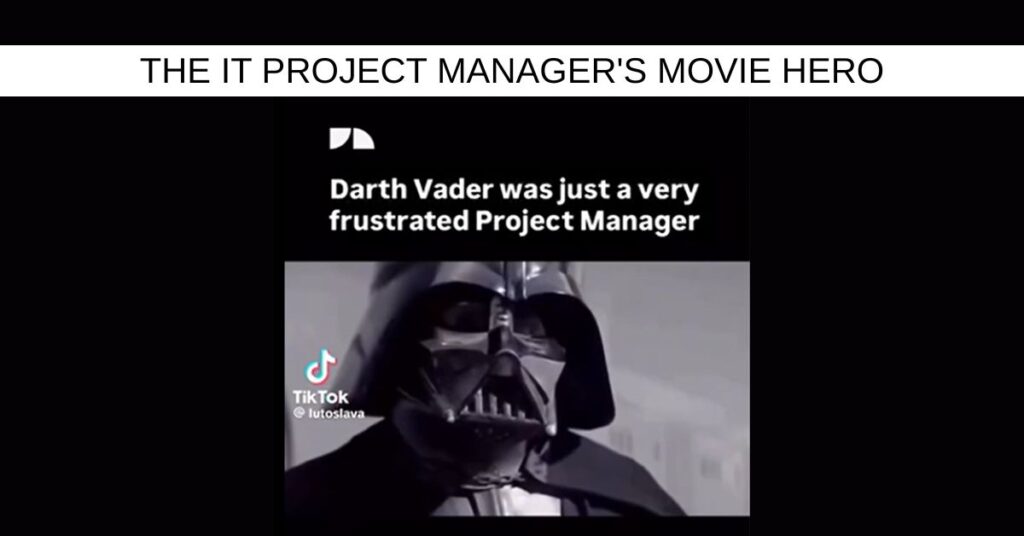
Was Darth Vader really just a frustrated project manager?
A viral video doing the rounds right now makes a compelling case that one of cinema’s greatest villains was a PM pushed too far!
Presented as evidence to back up the claim:
“The Death Star will be completed on schedule” (responsibility for keeping projects on time).
“I want to know what happened to the plans they sent” (tracking down missing layouts).
“I am altering the deal, pray I don’t alter it any further” (negotiating contracts).
“I’m here to put you back on schedule” (managing schedules).
“Be careful not to choke on your aspirations, Director” (leadership feedback).
“There will be a substantial reward for the one who finds the Millenium Falcon, you are free to use any methods necessary” (negotiating with subcontractors).
All sound familiar? Not only this … there is the desire to use the force to choke someone, the ominous breathing, the intolerance for missed deadlines – no wait – that’s just me sitting through a fourth scope-change meeting of the week.
That’s the dark side talking.
You don’t have to go there.
You can be the hero of the story instead.
Every hero’s journey follows the same arc. An ordinary person. An extraordinary challenge. A world that seems determined to grind them down. And a set of enemies, not always human, not always visible, that must be faced and defeated before the quest can be completed.
Modern project management is exactly that kind of quest.
The enemies are real. They have names. And they show up on every project, in every organisation, at every level of seniority.
What separates the heroes from the casualties isn’t talent or experience alone; it’s knowing what you’re facing and having the right weapons to hand.
I shared the viral Vader video with some industry colleagues, which led to us chatting about the villains we’d face in the movie of our project life.
It’s a bit of light relief in these darker times, with a potent message or two, and some helpful tips too.
Here are seven of the most dangerous villains in the modern project manager’s world, and how to defeat them.
Villain 1: The Scope Creep
The Scope Creep is the shapeshifter of the project world. It never announces itself. It arrives disguised as a reasonable request, just one small addition, a minor tweak, a quick extra feature, and by the time you notice it, the project has doubled in size without a single conversation about time or budget.
The defeat: A rigorously maintained scope document, owned by a named human and reviewed at every milestone. PMaaS brings dedicated project governance that treats scope as a living contract, visible to everyone, changeable only through a formal process, and always tied to a conversation about trade-offs. The Scope Creep cannot survive in that kind of light.
Find out more about Project Management as a Service from Stoneseed.
Villain 2: The Silent Consensus
This villain is almost invisible, which makes it one of the most dangerous. In hybrid and asynchronous working environments, silence has learned to impersonate agreement. A decision goes into a thread. Nobody objects. Everyone assumes it’s settled. Three weeks later, it surfaces in a meeting as though it was never made at all, and the work built on top of it starts to wobble.
The defeat: A decision log with teeth. Every open decision needs an owner, a deadline and a record of the trade-offs considered. PMaaS embeds this kind of structured accountability into the rhythm of a project, not as bureaucracy, but as protection. When decisions are documented and time-boxed, the Silent Consensus has nowhere to hide.
Villain 3: The Undead Project
You know this one. The initiative that should have been cancelled six months ago but is still consuming resources, still featuring in status reports, still occupying calendar space, because nobody has the political nerve to call it. The Undead Project doesn’t fail dramatically. It just drains everything around it, slowly and quietly, until there’s nothing left for the work that actually matters.
The defeat: Normalise the kill decision. Schedule stop reviews alongside start reviews. PMaaS introduces the discipline of intentional project closure, framed not as failure, but as strategic resource recovery. The Undead Project cannot survive in an environment where ending work is treated as a sign of good judgment rather than defeat.
Explore how Stoneseed’s PMO Services build that discipline into your delivery framework.
Villain 4: The Knowledge Void
A key team member leaves. And with them goes three years of context, relationships, undocumented decisions and institutional muscle memory, none of which ever made it into a system, because there was always something more urgent to do. The Knowledge Void doesn’t appear the day someone hands in their notice. It’s been growing for years. You just didn’t see it until the moment it mattered most.
The defeat: Knowledge management as a first-class project discipline, not an afterthought. PMaaS builds documentation and knowledge transfer into delivery rhythms from day one , ensuring that what’s learned is captured, structured and accessible, not held hostage in someone’s head. The Knowledge Void can only exist where documentation is optional.
Villain 5: The Eternal Extension
Just a few more days. It’s the most common sentence in project management, and the most corrosive. Every extension feels reasonable in isolation. Cumulatively, they destroy delivery credibility, compress downstream work, and send a quiet signal to every stakeholder that deadlines are really just suggestions. The Eternal Extension is charming and apologetic. That’s what makes it so effective.
The defeat: Treat deadlines as infrastructure, not preferences. The discipline here isn’t cruelty; it is realism built into planning from the start. PMaaS brings experienced project professionals who have seen the extension spiral too many times to let it begin. Realistic scoping, honest estimation and clear consequences for slippage are baked into the engagement model from day one.
Villain 6: The Invisible Misalignment
Everyone nods in the meeting. Everyone leaves with a different understanding of what was agreed. The Invisible Misalignment doesn’t announce itself; it masquerades as collaboration, as momentum, as a team that’s firing on all cylinders. It only reveals itself later, when work collides, when assumptions conflict, and when two teams discover they’ve been building toward entirely different destinations.
The defeat: A single source of truth, actively maintained and regularly interrogated. PMaaS creates the structures, weekly narrative updates, explicit ownership mapping, and documented trade-offs that force alignment into the open rather than assuming it exists. When everyone is reading from the same document, misalignment has to become visible before it becomes catastrophic.
Villain 7: The Vanishing Stakeholder
They were in the room at the kick-off. Enthusiastic, engaged, full of vision. By week six, their diary is unavailable. By week twelve, they’re reviewing outputs they haven’t been part of creating, with opinions formed in a vacuum. The Vanishing Stakeholder doesn’t mean to cause harm. But the absence of their air cover, their decisions, their escalations, and their advocacy leave projects dangerously exposed.
The defeat: Treat stakeholder engagement as a deliverable, not a given. PMaaS brings the experience to design stakeholder rhythms that are low-friction enough to sustain, concise updates, pre-made decisions, and “clear asks” rather than open-ended questions. When engagement is easy, stakeholders stay. When they stay, projects have the sponsorship they need to survive.
The Hero Doesn’t Go It Alone
Every great hero story has the same structural secret: the protagonist doesn’t win alone. They have a guide, a system, a set of tools they didn’t have at the beginning of the quest. The journey changes them, but it’s the support around them that makes the difference between surviving the villain and being defeated by it.
That’s what Project Management as a Service is, at its best. Not a set of templates or a reporting layer. A genuine partner in the fight, one that’s faced these villains before, knows how they move, and has the weapons ready before the battle starts.
The Scope Creep, the Silent Consensus, the Undead Project, the Knowledge Void, the Eternal Extension, the Invisible Misalignment, the Vanishing Stakeholder. They will probably all show up on your next project. It seems they show up on every project these days.
The question isn’t whether you’ll face them. It’s whether you’ll be ready when you do.
Facing any of these villains right now? Talk to Stoneseed about PMaaS.
More about Project Management as a Service from Stoneseed
Video links:
TikTok: https://vm.tiktok.com/ZNRGs8mMt/

